Picture this: It's the summer of 1938, and a Category 5 hurricane is churning toward New England.
The only thing standing between thousands of families and catastrophe is a crackling radio signal. No smartphones. No weather apps. No push notifications. Just a voice cutting through the static, telling people to run.
Nearly 700 people died in the Great New England Hurricane. Without the radio, that number would have been catastrophic. It's a sobering reminder that weather communication has never been just about convenience — it has always been, at its core, a matter of survival.
Five Distinct Eras of Weather Communication
Weather communication has traveled through five distinct technological phases: radio, television, cable, digital, and broadband. Here's the twist most people miss — none of them died. Radio still wails with emergency alerts. Local TV meteorologists still command the screen when a tornado watch drops. Cable still runs wall-to-wall coverage when a hurricane makes landfall. Digital and streaming have piled on top of it all.
The "future" of weather communication isn't a revolution. It's an avalanche — each new medium burying the old ones just enough to shift the landscape, but never quite erasing what came before.
For today's meteorologist, that means a genuinely wild daily juggling act. A single severe weather briefing might simultaneously air on television, push as a phone notification, stream on YouTube, and post to social media — each version re-shaped for its platform, its audience, and the precious seconds of attention it's competing for. The meteorologists thriving in this environment aren't bolting digital onto the side of their workflows as an afterthought. They're rebuilding their strategies from scratch.
Learn More: From TV to Streaming: Building A New Channel in Weather Coverage
AI: Force Multiplier, Not Magic Wand
Let's be honest about artificial intelligence for a second, because the conversation tends to swing between breathless hype and reflexive dismissal — and neither one is useful.
The real story? AI can chew through datasets at a speed no human team could match, draft initial forecast summaries, assist with graphics, and absorb hours of mind-numbing workflow tasks that used to devour a forecaster's day. That's genuinely valuable. It buys meteorologists something rare and precious: time.
What AI cannot do is make the call when the stakes are high, and the atmosphere isn't cooperating with the models. An experienced meteorologist carries something no algorithm has yet replicated — an intimate knowledge of local terrain, the quirks of a specific river valley, the way a particular ridge line tends to mess with storm tracks. They know how to communicate uncertainty in a way that moves people to act rather than shrug. That is not something you can train out of the equation.
The honest framing: AI handles the volume so the humans can focus their expertise where it actually matters.
Learn More: Leveraging AI to Support Meteorologists
The Tools Behind the Forecast
Here’s what viewers never see: when meteorologists have poor radar, delayed data, or clunky visualization tools, they’re not just inconvenienced — they’re trying to track a dangerous atmosphere without the precision they need most.
For decades, Baron has worked alongside broadcast meteorologists to build the radar systems, real-time data pipelines, and visualization platforms that turn raw atmospheric chaos into what you actually see on screen — whether that screen is a studio display, a laptop, or a phone in your pocket during a storm watch.
Learn More: From the Studio to the Screen: Visualizing Weather Data for Impact
Radio: When Speed Was Everything
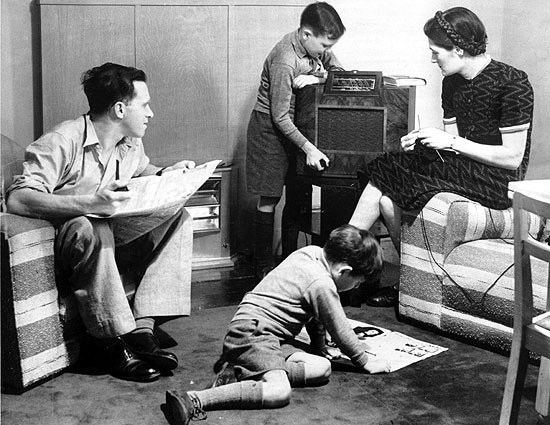
Before broadcast media, weather information traveled by newspaper and telegraph, so the forecast you received might already be a day old. For a farmer watching clouds build on the horizon or a fisherman reading the swells, that lag wasn't just frustrating. It was dangerous.
Radio ended that in an instant. Starting in the early 1920s, stations like KDKA in Pittsburgh began weaving weather updates into their programming, pulling live data from the U.S. Weather Bureau. Suddenly, a rural family in Ohio had the same real-time access to storm warnings as someone sitting in downtown Chicago. You just had to turn a dial.
Speed was radio's superpower, and speed saved lives — again and again, through the tornado outbreaks of the mid-20th century, through coastal storms and flooding events, through every weather emergency when a voice reaching millions at once was the only early warning system that existed.
The limitation, though, was built into the medium's DNA: no picture. No map. No way to show a viewer where the storm was, how big it was, or where it was going. Weather communication desperately needed eyes. Enter television.
Television: Weather Gets a Face
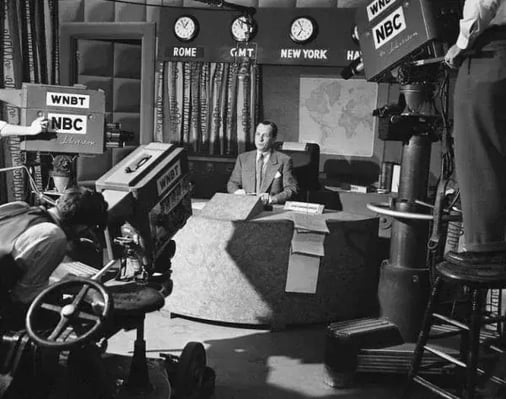
When TV arrived in American living rooms in the late 1940s and '50s, it handed meteorologists something radio never could — a canvas. Forecasters took to the air with hand-drawn maps, printed charts, and chunky magnetic icons they could slap on a board to show a cold front marching across the plains. Primitive by today's standards. Electrifying by any standard that came before.
But television did something subtler and arguably more important: it gave weather a face. Night after night, year after year, the same meteorologist appeared on screen in cities across the country — becoming not just a source of information, but a trusted presence in people's living rooms. When something serious was developing, viewers didn't just want a forecast. They wanted their meteorologist to walk them through it.
That kind of trust, built slowly through consistent local presence, is something digital platforms are still chasing decades later.
Cable: The 24-Hour Weather Machine
When The Weather Channel launched in May 1982, the critics lined up to bury it. A channel about just weather? Who would watch that?
Fifty million subscribers a decade later, that's who.
But TWC didn't invent the idea of round-the-clock weather coverage — it nationalized it. Local television meteorologists had been doing that work long before a cable network made it a programming category. When a significant storm threatened their community, local stations didn't sign off and pick back up in the morning. They stayed on the air as long as the threat was active — sometimes for days — because their viewers needed them to. That kind of hyperlocal commitment to a specific place and audience was something a national network, by design, couldn't fully replicate.
What The Weather Channel added was scale. For the first time, viewers could check in at any hour to see whether a storm was on the way. You could tune in at 3 a.m. before a cross-country drive. You could watch a developing hurricane in real time, hour by hour, as it churned toward the coast. TWC also hit the market at a fortuitous moment — Doppler radar, satellite imagery, and computer graphics were all maturing simultaneously, giving meteorologists everywhere the tools to depict the atmosphere in ways never before possible.
By the time cable weather reached full stride, the humble two-minute segment at the end of the evening news had evolved into a full-blown broadcast discipline, complete with its own storytelling conventions, technical standards, and audience expectations.
Digital: The Double-Edged Revolution
When Weather.com went live in 1996, the shift wasn't just technological — it was philosophical. Audiences no longer waited for the forecast to come to them. They went and got it themselves, any time, on their own terms.
Interactive radar. Hour-by-hour breakdowns. Real-time severe weather alerts in your inbox before the sirens went off. By the early 2000s, all of it was available around the clock to anyone with an internet connection.
But the digital era came with a catch that still hasn't been fully resolved: when the barrier to publishing drops to almost zero, anyone can publish weather information. Publishing fast and publishing accurately are not the same thing. The organizations that have maintained their credibility in the digital era are the ones that refused to sacrifice accuracy on the altar of speed — even when the pressure to be first was almost unbearable.
Broadband: Weather Without Borders
Broadband didn't just expand where weather information lived. It blew up who gets to produce and deliver it in the first place.
As video streaming matured in the mid-2000s, a credentialed meteorologist suddenly didn't need a television contract, a satellite uplink, or a network timeslot to reach a national audience. They needed a camera, an internet connection, and something worth saying. Today, a forecaster can broadcast a live severe weather update from a home office and be watched in real time from coast to coast via YouTube, Facebook Live, or any number of dedicated streaming platforms.
In 1982, that was science fiction. Today, it's Tuesday.
For weather organizations rethinking how they reach their audiences, the implications are still unfolding. A forecast that once traveled only as far as a broadcast signal could reach can now follow a viewer anywhere on earth with a connection. The trusted local meteorologist — made familiar by television, made continuous by cable — can now be genuinely everywhere.
Learn More: You're Not Alone: Navigating the Meteorologist Migration to Digital
What Never Changes
The platforms will keep evolving. The models will keep improving. New tools will emerge that make today's technology look as quaint as a hand-drawn weather map.
But the core challenge? It hasn't moved an inch in a hundred years: take the raw, beautiful, terrifying complexity of the atmosphere and turn it into something ordinary people can understand, trust, and act on — often in the time it takes a storm to go from a radar signature to a wall of hail outside your window.
Every technological leap in weather communication history has been worth making precisely because it served that mission better than what came before. The platforms changed. The mission didn't. That's the pattern worth holding onto as the next chapter begins.